

THIS ISSUE
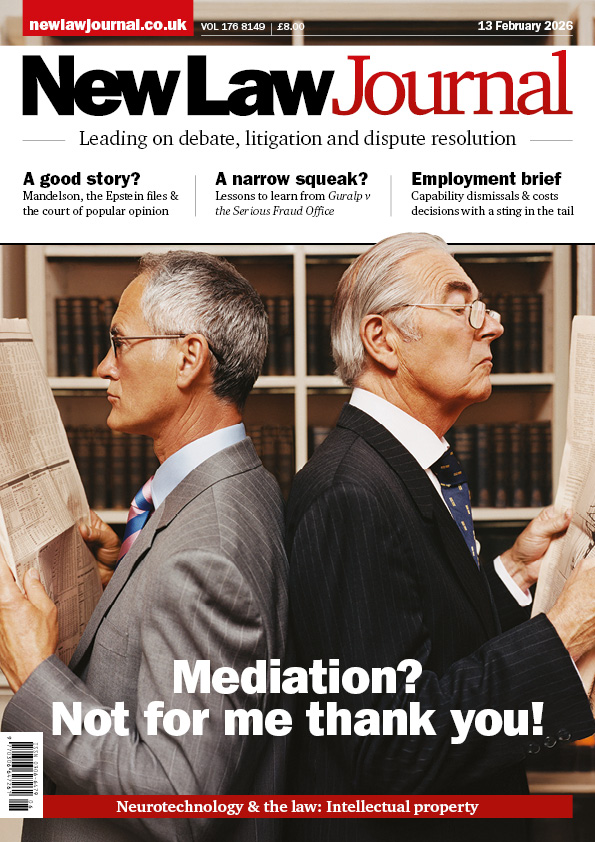


David Locke on Lord Mandelson, the Epstein files & the court of popular opinion
Paul McKeown, Adrian Keane & Sally Stares analyse the problems with the current directions on the criminal standard of proof
Neurotechnology is advancing at breakneck speed—but can existing patent law keep up? Larissa Bifano, Rebecca Lawrence & Harry Lambert examine the IP challenges facing innovators in the UK & US
The Police and Criminal Evidence Act 1984 transformed criminal justice. Writing in NLJ this week, Ed Cape of UWE and Matthew Hardcastle and Sandra Paul of Kingsley Napley trace its ‘seismic impact’
Ed Cape, Matthew Hardcastle & Sandra Paul look back on 40 years of the Police and Criminal Evidence Act 1984
Operational resilience is no longer optional. Writing in NLJ this week, Emma Radmore and Michael Lewis of Womble Bond Dickinson explain how UK regulators expect firms to identify ‘important business services’ that could cause ‘intolerable levels of harm’ if disrupted
Criminal juries may be convicting—or acquitting—on a misunderstanding. Writing in NLJ this week Paul McKeown, Adrian Keane and Sally Stares of The City Law School and LSE report troubling survey findings on the meaning of ‘sure’
The Serious Fraud Office (SFO) has narrowly preserved a key weapon in its anti-corruption arsenal. In this week's NLJ, Jonathan Fisher KC of Red Lion Chambers examines Guralp Systems Ltd v SFO, in which the High Court ruled that a deferred prosecution agreement (DPA) remained in force despite the company’s failure to disgorge £2m by the stated deadline
As the drip-feed of Epstein disclosures fuels ‘collateral damage’, the rush to cry misconduct in public office may be premature. Writing in NLJ this week, David Locke of Hill Dickinson warns that the offence is no catch-all for political embarrassment. It demands a ‘grave departure’ from proper standards, an ‘abuse of the public’s trust’ and conduct ‘sufficiently serious to warrant criminal punishment’
Employment law is shifting at the margins. In his latest Employment Law Brief for NLJ this week, Ian Smith of Norwich Law School examines a Court of Appeal ruling confirming that volunteers are not a special legal species and may qualify as ‘workers’

MOVERS & SHAKERS


Gateley Legal—Jack Kelly
Gateley Legal expands Midlands residential development team

Gibson Dunn—Richard Surtees
Gibson Dunn adds employee benefits and executive compensation practice in London with partner Richard Surtees

Laytons ETL—Alec Cameron
Laytons ETL appoints new partner and head of intellectual property disputes
NEWS
A series of recent decisions has clarified important principles across property law, from perpetuities to lease renewals and public rights over land
A series of recent decisions has clarified important principles across property law, from perpetuities to lease renewals and public rights over land
Employers cannot rely on wellbeing services alone to defend workplace stress claims after a High Court decision awarding almost £1m to an overworked employee
Andy Burnham's brand of 'Manchesterism' could offer fresh thinking on legal aid and access to justice if it reaches Westminster, according to Roger Smith, NLJ columnist and former director of JUSTICE
The constitutional fallout from a change of prime minister, rather than the politics, is under scrutiny as questions arise over the limits of executive authority in a leadership transition
Copyright © 2026 LexisNexis

