

THIS ISSUE

A dispute between Ryanair and hundreds of its pilots could bring about a new route for trade union detriment claims, writes Charles Pigott, professional support lawyer, Mills & Reeve, in this week’s NLJ.
The decision to remove the three-year primary limitation period for claims arising from child sexual abuse has been welcomed by abuse survivors, Richard Scorer, head of abuse law and public inquiries at Slater & Gordon, writes in this week’s NLJ.
Bats in court? It can only be the latest report from The Insider, AKA NLJ columnist Professor Dominic Regan of City Law School.
Memory is fallible, so how should litigation lawyers be aware of this when preparing witness statements? Mary Young, partner, and Laurence Clarke, senior associate, in the dispute resolution team at Kingsley Napley, discuss the unreliability of memory and court procedure rules introduced nearly four years ago on record-keeping and preparation of witness statements.
The UK government has the power to review and potentially stop any business transactions that could threaten national security, courtesy of legislation that came into effect at the start of 2022. In this week’s NLJ, Ludovica Pizzetti, counsel, Arnold & Porter, looks at the operation to date of this legislation, the UK National Investment and Security Act 2021 (NSIA 2021).
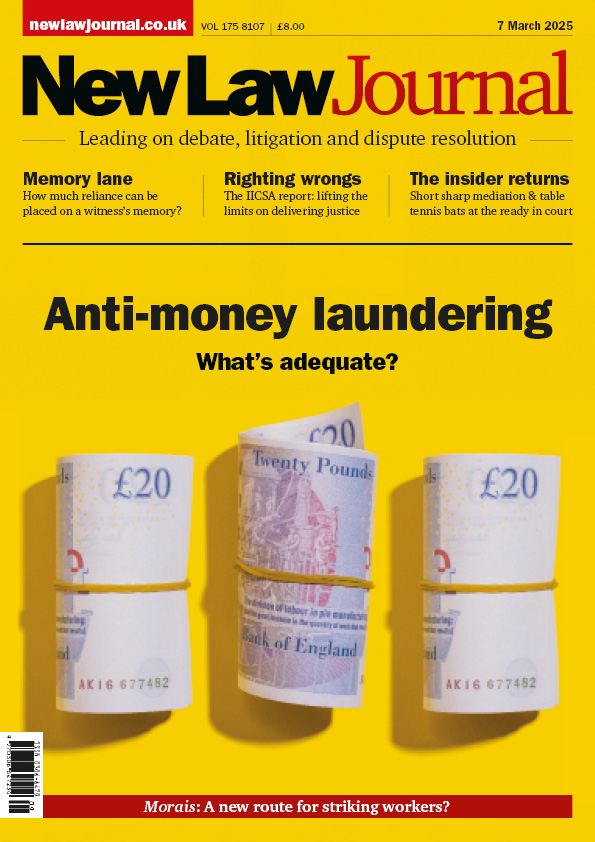
Is the anti-money laundering regime too vague? In this week’s NLJ, Jonathan Fisher KC, Red Lion Chambers, looks at two recent cases involving solicitors where the standards applied were assessed according to whether they were ‘adequate’ or ‘appropriate’.

This month, Dominic Regan covers leapfrog appeals, ‘short sharp mediation’, the role of juniors & table tennis bats in court
Righting wrongs: Richard Scorer welcomes the removal of time limits on civil claims for child sexual abuse
How much reliance can be placed on a witness’s memory? Mary Young & Laurence Clarke consider the challenges of determining truth & credibility in evidence
The definition of ‘property’ is about to expand: Jessica Boxford, Joseph Evans & Cassidy Fan explore the impact on insolvency practitioners

MOVERS & SHAKERS


Gateley Legal—Jack Kelly
Gateley Legal expands Midlands residential development team

Gibson Dunn—Richard Surtees
Gibson Dunn adds employee benefits and executive compensation practice in London with partner Richard Surtees

Laytons ETL—Alec Cameron
Laytons ETL appoints new partner and head of intellectual property disputes
NEWS
A series of recent decisions has clarified important principles across property law, from perpetuities to lease renewals and public rights over land
A series of recent decisions has clarified important principles across property law, from perpetuities to lease renewals and public rights over land
Employers cannot rely on wellbeing services alone to defend workplace stress claims after a High Court decision awarding almost £1m to an overworked employee
Andy Burnham's brand of 'Manchesterism' could offer fresh thinking on legal aid and access to justice if it reaches Westminster, according to Roger Smith, NLJ columnist and former director of JUSTICE
The constitutional fallout from a change of prime minister, rather than the politics, is under scrutiny as questions arise over the limits of executive authority in a leadership transition
Copyright © 2026 LexisNexis

