

THIS ISSUE

A senior paralegal at Bishopsgate Law is packing her bags after being chosen as the lucky winner of InfoTrack’s seventh annual ‘Take Me To Australia’ prize draw.
Recent caselaw on vicarious liability, quantum and the process of seeking permission for a civil claim for injuries occurring while committing an imprisonable offence for which the potential claimant was later convicted, are all discussed in NLJ’s personal injury update column this week. Vijay Ganapathy, partner at Leigh Day specialising in industrial disease and complex injury cases, explores the issues in each case.
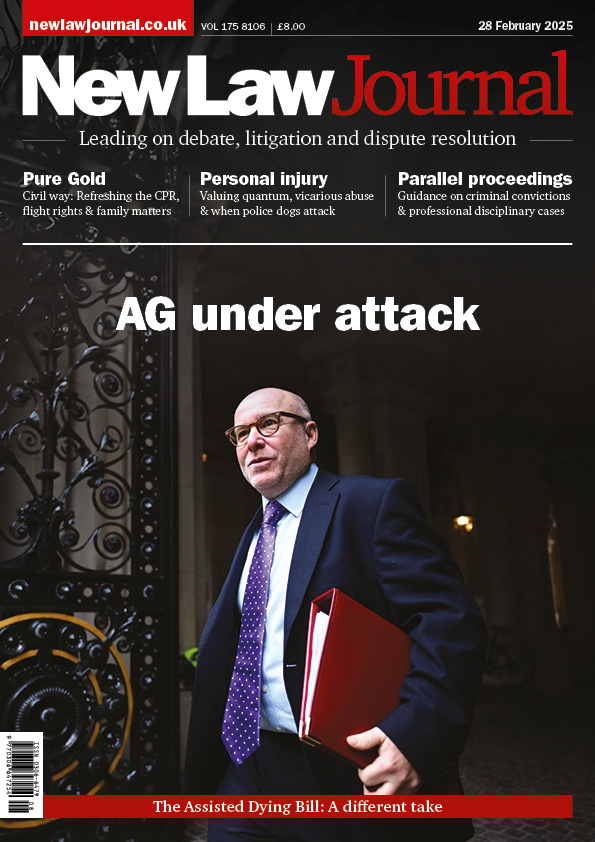
Recent attacks by MPs on the Attorney General, Lord Hermer on the basis of clients he once represented are ‘uninformed’ and concerning, John Gould, senior partner at Russell-Cooke, writes in this week’s NLJ.
It’s often a case of double trouble where regulated professionals face criminal charges because they also face professional disciplinary proceedings. In this week’s NLJ, Vanessa Reid, senior associate at Corker Binning, looks at a recent High Court decision, Patel, in which a dentist who caused death by careless driving received criminal sanctions and was also brought before the General Dental Council’s disciplinary committee.
Ever met a psychopath? Do you really know what a psychopath is? In this week’s NLJ, Dr Tanya Garrett, clinical and forensic psychologist, sets out how to recognise the personality disorder known as psychopathy and explains why ‘understanding whether someone has psychopathic traits is important for considering parenting capacity, risk and identifying what interventions are needed’.
Is the Terminally Ill Adults (End of Life) Bill as radical as many critics would have us believe? In this week’s NLJ, Professor Graham Zellick KC, a Senior Master of the Bench, asserts it is not.
Is it spring already? In this week’s NLJ, former district judge Stephen Gold looks ahead to a cluster of changes due to take place in April. These range from an increase in the allowable costs for a medical report in low-value whiplash claims to two three-year budgeting pilots.

Condemning an Attorney General based on their past client list shows a fundamental misunderstanding of the rule of law, writes John Gould
The Terminally Ill Adults (End of Life) Bill is not the seminal, fundamental reform it is said to be, argues Graham Zellick
Two sets of consequences for the same actions? Vanessa Reid examines guidance from the courts on criminal convictions & professional disciplinary cases

MOVERS & SHAKERS


Gateley Legal—Jack Kelly
Gateley Legal expands Midlands residential development team

Gibson Dunn—Richard Surtees
Gibson Dunn adds employee benefits and executive compensation practice in London with partner Richard Surtees

Laytons ETL—Alec Cameron
Laytons ETL appoints new partner and head of intellectual property disputes
NEWS
A series of recent decisions has clarified important principles across property law, from perpetuities to lease renewals and public rights over land
A series of recent decisions has clarified important principles across property law, from perpetuities to lease renewals and public rights over land
Employers cannot rely on wellbeing services alone to defend workplace stress claims after a High Court decision awarding almost £1m to an overworked employee
Andy Burnham's brand of 'Manchesterism' could offer fresh thinking on legal aid and access to justice if it reaches Westminster, according to Roger Smith, NLJ columnist and former director of JUSTICE
The constitutional fallout from a change of prime minister, rather than the politics, is under scrutiny as questions arise over the limits of executive authority in a leadership transition
Copyright © 2026 LexisNexis

