

THIS ISSUE

While rare, the courts can make passport orders to prevent judgment debtors leaving the country. In this week’s NLJ, Chris Bryden and Clara Parry discuss the use of this legal technique and how these orders are enforced.
The government is considering cutting funding for level 7 apprenticeships, which could ‘seriously impact social mobility in the legal profession’, Rhicha Kapila, partner and chief operating officer at Bolt Burdon Kemp, writes in this week’s NLJ. Level 7, the highest level of apprenticeships, ‘create a qualification path for graduates’ that allows them to be paid while they train.
The personal injury discount rate was increased to 0.5% in January, based for the first time on a detailed report by an expert panel. In this week’s NLJ, Julian Chamberlayne wonders whether the decision-making is vulnerable to challenge by judicial review, and uncovers a multitude of weak spots.
There is an urgent need for clarity regarding the UK’s laws on the use of copyrighted material protection by artificial intelligence (AI) technology, writes Emma Kennaugh-Gallacher, senior professional support lawyer at Mewburn Ellis, in this week’s NLJ.
Horses for courses, a lid for every pot and costs lawyers for costs (regulated, of course). Otherwise, it could all turn into a shambles. In this week’s NLJ, Jack Ridgway, chair of the Association of Costs Lawyers and a senior associate costs lawyer at Bolt Burdon Kemp, highlights the perils of using an unregulated costs draftsman.
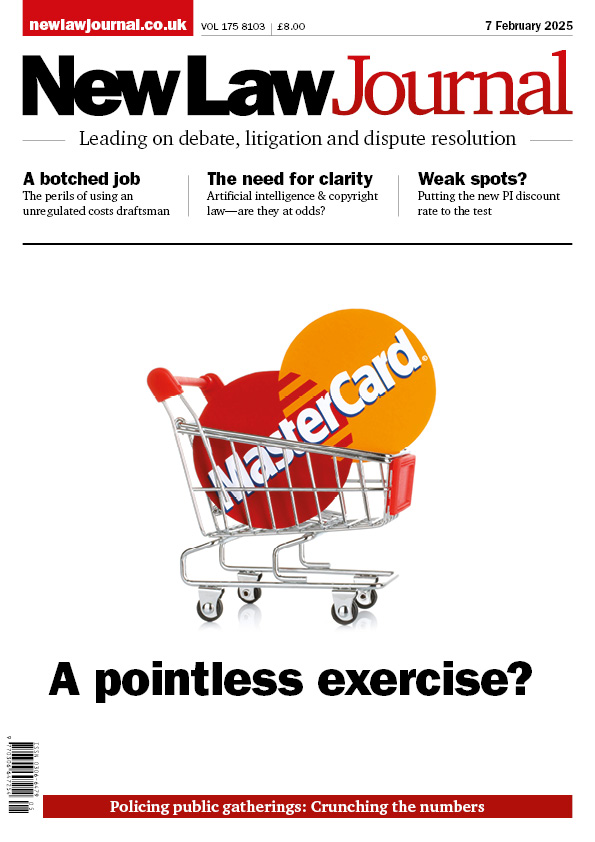
How will you spend your £4 Mastercard pay-out? Professor Dominic Regan, NLJ columnist, AKA 'The Insider', writes that the result of the collective action once put at £10bn and later settled for £200m renders it a ‘pointless exercise’.

How will you spend your £4 Mastercard payout? Dominic Regan tots up collective action anti-climaxes & laments expectation versus reality
Cutting apprenticeships is a step backwards for the profession & for social mobility, says Rhicha Kapila
Julian Chamberlayne reviews the new personal injury discount rate & highlights some potential weak spots
Chris Bryden & Clara Parry discuss the rare use of passport orders to prevent someone leaving the country—and how these orders are enforced

MOVERS & SHAKERS


Gateley Legal—Jack Kelly
Gateley Legal expands Midlands residential development team

Gibson Dunn—Richard Surtees
Gibson Dunn adds employee benefits and executive compensation practice in London with partner Richard Surtees

Laytons ETL—Alec Cameron
Laytons ETL appoints new partner and head of intellectual property disputes
NEWS
A series of recent decisions has clarified important principles across property law, from perpetuities to lease renewals and public rights over land
A series of recent decisions has clarified important principles across property law, from perpetuities to lease renewals and public rights over land
Employers cannot rely on wellbeing services alone to defend workplace stress claims after a High Court decision awarding almost £1m to an overworked employee
Andy Burnham's brand of 'Manchesterism' could offer fresh thinking on legal aid and access to justice if it reaches Westminster, according to Roger Smith, NLJ columnist and former director of JUSTICE
The constitutional fallout from a change of prime minister, rather than the politics, is under scrutiny as questions arise over the limits of executive authority in a leadership transition
Copyright © 2026 LexisNexis

