

THIS ISSUE
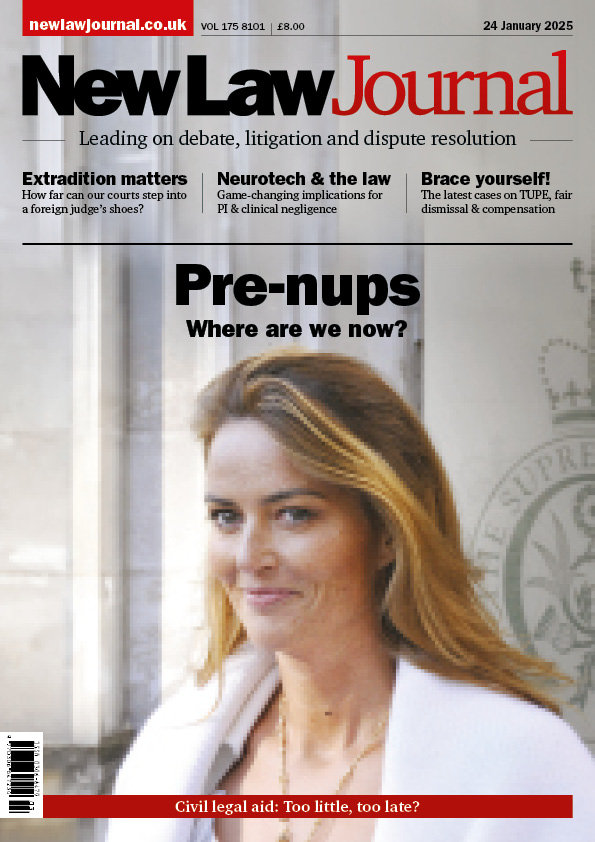

A test case on extradition has been granted permission to appeal to the Supreme Court. Writing in this week’s NLJ, George Hepburne Scott, barrister at Church Court Chambers, explains the issue—a lack of consensus among High Court judges about the extent to which they can take account of the prospect of early release overseas.
The validity of pre-nuptial agreements remains an inexact science. In this week’s NLJ, Mark Pawlowski, barrister and professor emeritus of property law, School of Law, University of Greenwich, examines recent caselaw, including cases involving foreign pre-nups where parties have subsequently sought divorce in the English courts.
Advances in implantable neurotechnologies could have a profound impact on rehabilitation, with consequent game-changing implications for personal injury and clinical negligence claims, Harry Lambert, barrister at Crown Office Chambers, explains in this week’s NLJ.
Two defendant states, Spain and Zimbabwe, who challenged the registration in English courts of arbitration awards made against them, came a cropper in the Court of Appeal last year. Writing in this week’s NLJ, international arbitration specialists Neil Newing, partner, and Pietro Grassi, senior associate, at Signature Litigation, explore the ruling in the combined case and its implications.
The Ministry of Justice’s latest review of civil justice has failed to inspire Roger Smith, former director of Justice. In his NLJ column this week, he reveals he read all seven reports over the new year and ‘did so with a heavy heart’.

Reading between the lines of the government’s latest review of the civil legal aid system, Roger Smith unearths the same old fundamental problems at its heart
To what extent are pre-nuptial agreements now recognised under English law? Mark Pawlowski weighs up the latest decisions
Ian Smith recommends a stiff drink & a towel around the head before plunging into the latest cases on TUPE, fair dismissal & enhanced compensation
To what extent can an English extradition court take account of the prospect of early release overseas? George Hepburne Scott calls for clarity
Coming advances in neurotechnology & their potential impact upon rehabilitation will be nothing short of transformational: Harry Lambert outlines their game-changing implications for personal injury & clinical negligence

MOVERS & SHAKERS


Gateley Legal—Jack Kelly
Gateley Legal expands Midlands residential development team

Gibson Dunn—Richard Surtees
Gibson Dunn adds employee benefits and executive compensation practice in London with partner Richard Surtees

Laytons ETL—Alec Cameron
Laytons ETL appoints new partner and head of intellectual property disputes
NEWS
A series of recent decisions has clarified important principles across property law, from perpetuities to lease renewals and public rights over land
A series of recent decisions has clarified important principles across property law, from perpetuities to lease renewals and public rights over land
Employers cannot rely on wellbeing services alone to defend workplace stress claims after a High Court decision awarding almost £1m to an overworked employee
Andy Burnham's brand of 'Manchesterism' could offer fresh thinking on legal aid and access to justice if it reaches Westminster, according to Roger Smith, NLJ columnist and former director of JUSTICE
The constitutional fallout from a change of prime minister, rather than the politics, is under scrutiny as questions arise over the limits of executive authority in a leadership transition
Copyright © 2026 LexisNexis

