

THIS ISSUE
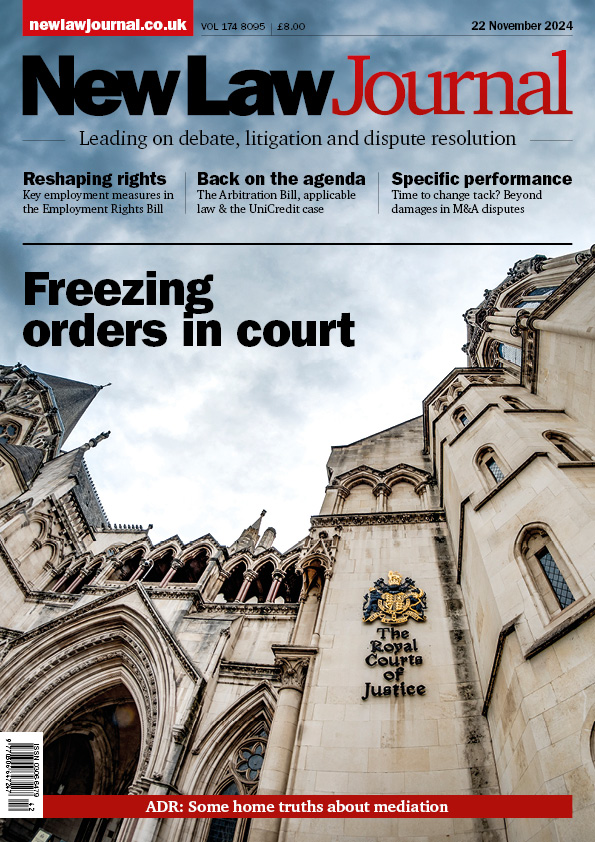

Freezing injunctions are 50 years old next year and still very much a developing area of law. In this week’s NLJ, Mary Young, partner, and Charlotte Dormon, associate, in the dispute resolution team at Kingsley Napley, take us through a raft of cases decided this year.
Should an immoral regime rise to power, it is tempting to think lawyers and the rule of law would act as a protective wall. But is this true? Sadly, history suggests not, as John Gould, chair of Russell-Cooke, writes in this week’s NLJ.
Retired costs judge John O’Hare discusses ADR in three contexts, in this week’s NLJ. He covers cases provisionally allocated to the small claims track, commercial litigation in the County Court, and claims opposed by liability insurers or by large self-insuring organisations such as local authorities or health authorities.
Ambiguity over the governing law of arbitration agreements continues to spark debate. In July, meanwhile, the government reintroduced the Arbitration Bill, which would have altered the outcome in September of the Supreme Court case, UniCredit. In this week’s NLJ, Valya Georgieva, senior associate, Penningtons Manches Cooper, and Ravi Aswani, barrister, 36 Group, examine the court’s reasoning and consider how the outcome might have differed if the Arbitration Bill, currently before Parliament, had been in force.
The remedy of ‘specific performance’ is little-used but can be ‘extremely beneficial’ in M&A disputes. In this week’s NLJ, Yasseen Gailani, partner, and Megan Hiluta, senior associate, Quinn Emanuel, explain why looking beyond the remedy of damages may pay dividends for clients.

In a system ruled by immoral leaders, it may be fanciful to believe that lawyers can or will make a difference: John Gould considers a chilling lesson from history
Even after five decades of freezing injunctions, the courts are still regularly asked to clarify the law: Mary Young & Charlotte Dormon round up this year’s causes of confusion
Charles Pigott outlines key employment measures contained within the government’s Employment Rights Bill
Yasseen Gailani & Megan Hiluta consider the advantages of the little-used remedy of ‘specific performance’
The Arbitration Bill is back on the agenda—but how would it have affected the outcome of the UniCredit case? Valya Georgieva & Ravi Aswani consider the implications

MOVERS & SHAKERS


Gateley Legal—Jack Kelly
Gateley Legal expands Midlands residential development team

Gibson Dunn—Richard Surtees
Gibson Dunn adds employee benefits and executive compensation practice in London with partner Richard Surtees

Laytons ETL—Alec Cameron
Laytons ETL appoints new partner and head of intellectual property disputes
NEWS
A series of recent decisions has clarified important principles across property law, from perpetuities to lease renewals and public rights over land
A series of recent decisions has clarified important principles across property law, from perpetuities to lease renewals and public rights over land
Employers cannot rely on wellbeing services alone to defend workplace stress claims after a High Court decision awarding almost £1m to an overworked employee
Andy Burnham's brand of 'Manchesterism' could offer fresh thinking on legal aid and access to justice if it reaches Westminster, according to Roger Smith, NLJ columnist and former director of JUSTICE
The constitutional fallout from a change of prime minister, rather than the politics, is under scrutiny as questions arise over the limits of executive authority in a leadership transition
Copyright © 2026 LexisNexis

