

THIS ISSUE
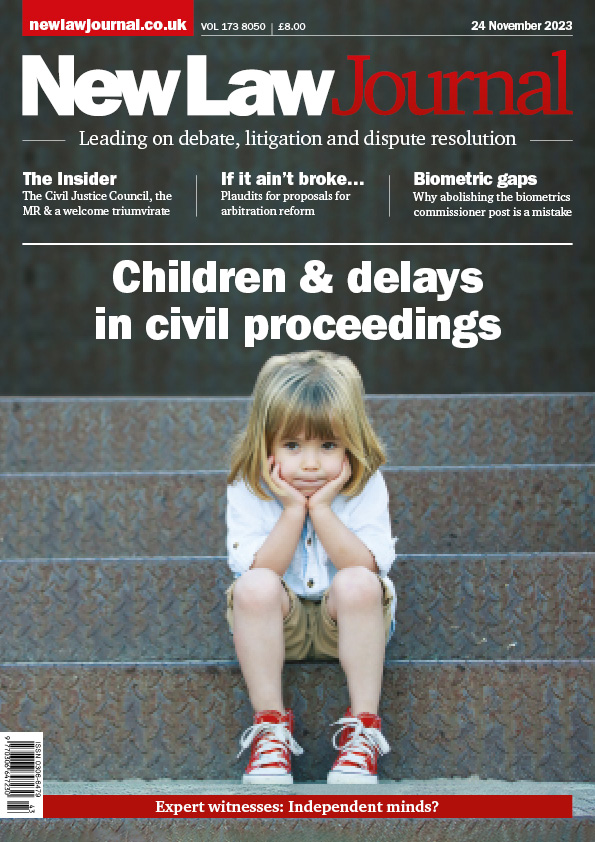


Mark Solon explores some of the reasons why experts might feel compelled to forgo their overriding responsibilities to the court
Rakesh Kapila considers the financial aspects of fraudulent trading
Prof Regan defends the MR, condemns the Solicitors Act 1974, & commends a legal triumvirate
Sukhninder Panesar covers recent developments affecting proprietary estoppel, including a son’s claim to the farm he was promised
Driven to distraction by financial & other businesses failing to respond to essential enquiries? Stephen Gold recommends taking the compensation route
Abolishing the post of the biometrics commissioner would be a mistake, says Michael Zander KC
Chris Ward & Clare Arthurs survey (& commend) the Law Commission’s proposals for arbitration reform
David Burrows on why the law must not discriminate against children involved in Pt 2 proceedings
Amanda Hamilton offers some valuable advice on developing a career as a paralegal

MOVERS & SHAKERS


Gateley Legal—Jack Kelly
Gateley Legal expands Midlands residential development team

Gibson Dunn—Richard Surtees
Gibson Dunn adds employee benefits and executive compensation practice in London with partner Richard Surtees

Laytons ETL—Alec Cameron
Laytons ETL appoints new partner and head of intellectual property disputes
NEWS
A series of recent decisions has clarified important principles across property law, from perpetuities to lease renewals and public rights over land
A series of recent decisions has clarified important principles across property law, from perpetuities to lease renewals and public rights over land
Employers cannot rely on wellbeing services alone to defend workplace stress claims after a High Court decision awarding almost £1m to an overworked employee
Andy Burnham's brand of 'Manchesterism' could offer fresh thinking on legal aid and access to justice if it reaches Westminster, according to Roger Smith, NLJ columnist and former director of JUSTICE
The constitutional fallout from a change of prime minister, rather than the politics, is under scrutiny as questions arise over the limits of executive authority in a leadership transition
Copyright © 2026 LexisNexis

