

THIS ISSUE
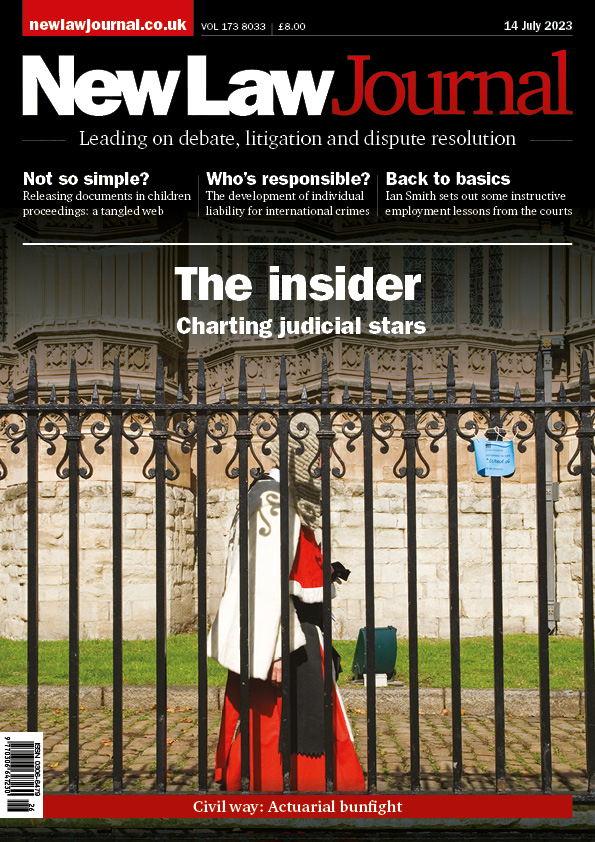

Which judges are tipped for the top jobs? In this week’s 'Insider', Professor Dominic Regan, of City Law School, praises Dame Sue Carr, the next Chief Justice, and reveals how her career could have taken an alternative albeit still high-profile trajectory!
Rules should be ‘simple and simply expressed’, according to the Courts Act 2003—yet Mr Justice Mostyn recently urged rule-makers to look again at the ‘Byzantine’ rules governing the release of documents to children proceedings.
The rise of legal consultants has been a game-changer for lawyers who want to work independently, manage their own caseload, and reduce the burdens of self-employment. In this week’s NLJ, Adrian Jaggard, CEO at AllC Group & Taylor Rose MW, looks ahead to the expansion of this model of working—research suggests one third of lawyers will work this way by 2026—and offers advice on how to prepare now for the changes to come.
The Nuremberg trials laid the groundwork for personal international criminal liability, and the process by which Vladimir Putin may one day be held responsible. In this week’s NLJ, Simon Parsons, associate lecturer at Bath Spa University, looks at the lack of individual liability for international crime before 1945.

As the courts gear up for the Long Vacation, Dominic Regan charts judicial stars on the rise & recommends a handy surgical procedure for costs lawyers
Back to school already? Ian Smith sets out some instructive lessons from the courts on the definition of a worker, the conduct of disciplinary hearings, & the perils of making a mistake
A Byzantine set of rules governs the release of documents in children proceedings: David Burrows calls for some sorely-needed simplicity
The courts in the Cayman Islands have shown a willingness to explore the link between insolvency & trust law in resolving novel issues: Christopher Levers & Jordan Constable analyse a recent example
In the first of a two-part series, Simon Parsons charts the development of individual liability for international crimes
Service without a seal; reducing tax penalties; no jokes: the Glancing blow; coughing impecuniosity; actuarial bunfight; chancery talk.

MOVERS & SHAKERS


Gateley Legal—Jack Kelly
Gateley Legal expands Midlands residential development team

Gibson Dunn—Richard Surtees
Gibson Dunn adds employee benefits and executive compensation practice in London with partner Richard Surtees

Laytons ETL—Alec Cameron
Laytons ETL appoints new partner and head of intellectual property disputes
NEWS
A series of recent decisions has clarified important principles across property law, from perpetuities to lease renewals and public rights over land
Employers cannot rely on wellbeing services alone to defend workplace stress claims after a High Court decision awarding almost £1m to an overworked employee
Andy Burnham's brand of 'Manchesterism' could offer fresh thinking on legal aid and access to justice if it reaches Westminster, according to Roger Smith, NLJ columnist and former director of JUSTICE
The constitutional fallout from a change of prime minister, rather than the politics, is under scrutiny as questions arise over the limits of executive authority in a leadership transition
The legal profession is undergoing a fundamental shift from selling services to creating technology-enabled products, according to Professor Luke Mason, Head of School of Law at Regent's University London
Copyright © 2026 LexisNexis

