
header-logo header-logo

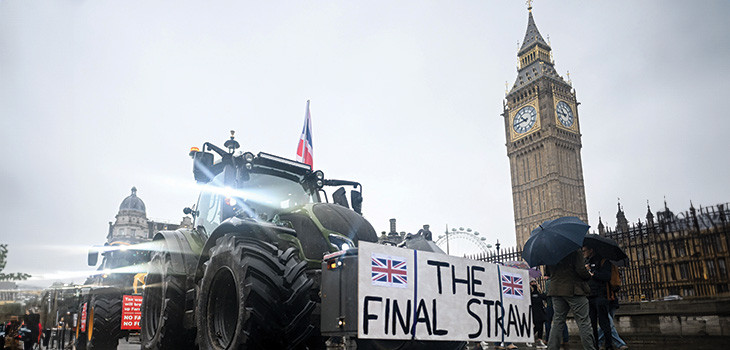
Cold comfort for farmers

29 November 2024 / William Gibson
Issue: 8096 / Categories: Features , Inheritance tax , Employment
printer mail-detail
199155
With angry farmers hitting the headlines, William Gibson recalls an earlier story of rural revolt & how justice was finally served

Sir Keir Starmer’s government isn’t the first to engage the farming industry in battle. Chancellor Rachel Reeves can expect a rural backlash to her budget even more effective than the last one.

In 1834, six farm labourers from Tolpuddle in Dorset formed a secret society, aimed at improving agricultural wages and countering exploitation by landowners. They swore an oath: ‘If any master reduces wages, all members of the Society would walk out.’

The Friendly Society of Agricultural Labourers

During the Napoleonic Wars, providing the forces with food at inflated prices had made farm owners wealthy and allowed them to invest in labour-saving machinery. When the conflict ended in 1815, demand fell drastically, as did prices; labourers were sacked and wages reduced for those remaining. The highest paid labourers earned nine shillings a week (less than £20 in today’s money). A married labourer with children over the age of six could put the family to work and add perhaps another

If you are not a subscriber, subscribe now to read this content
If you are already a subscriber sign in
...or Register for two weeks' free access to subscriber content

MOVERS & SHAKERS

Muckle LLP—Stacey Brown

Muckle LLP—Stacey Brown

Corporate governance and company law specialist joins the team

Excello Law—Heather Horsewood & Darren Barwick

Excello Law—Heather Horsewood & Darren Barwick

North west team expands with senior private client and property hires

Ward Hadaway—Paul Wigham

Ward Hadaway—Paul Wigham

Firm boosts corporate team in Newcastle to support high-growth technology businesses

NEWS

NOTICE UNDER THE TRUSTEE ACT 1925

HERBERT SMITH STAFF PENSION SCHEME (THE “SCHEME”)

NOTICE TO CREDITORS AND BENEFICIARIES UNDER SECTION 27 OF THE TRUSTEE ACT 1925
Law firm HFW is offering clients lawyers on call for dawn raids, sanctions issues and other regulatory emergencies
From gender-critical speech to notice periods and incapability dismissals, employment law continues to turn on fine distinctions. In his latest employment law brief for NLJ, Ian Smith of Norwich Law School reviews a cluster of recent decisions, led by Bailey v Stonewall, where the Court of Appeal clarified the limits of third-party liability under the Equality Act
Non-molestation orders are meant to be the frontline defence against domestic abuse, yet their enforcement often falls short. Writing in NLJ this week, Jeni Kavanagh, Jessica Mortimer and Oliver Kavanagh analyse why the criminalisation of breach has failed to deliver consistent protection
Assisted dying remains one of the most fraught fault lines in English law, where compassion and criminal liability sit uncomfortably close. Writing in NLJ this week, Julie Gowland and Barny Croft of Birketts examine how acts motivated by care—booking travel, completing paperwork, or offering emotional support—can still fall within the wide reach of the Suicide Act 1961
back-to-top-scroll
