
header-logo header-logo

10 April 2024
Issue: 8066 / Categories: Legal News , Human rights , Environment , Climate change litigation , EU
printer mail-detail

Swiss success in climate change claim

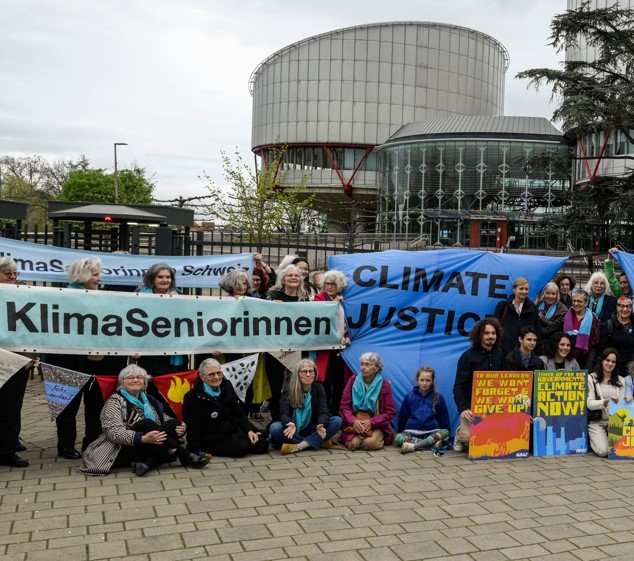
A group of more than 2,000 Swiss women aged above 64 years old have won a landmark case on climate change at the European Court of Human Rights

In Verein KlimaSeniorinnen Schweiz and Others v Switzerland (application no 53600/20), the group successfully argued their government’s inaction breached their Art 2 rights as their age and gender made them particularly susceptible to dying during heatwaves.

The Strasbourg court held by a 16:1 majority the Swiss authorities had breached Art 8 (private and family life) and, unanimously, they had breached Art 6(1) (access to court).

Specifically, the court found the Swiss authorities had failed to quantify, through a carbon budget or otherwise, national greenhouse gas emissions limitations, had failed to meet its past reduction targets, and had not acted in time and in an appropriate way to devise, develop and implement relevant legislation and measures.

Vesselina Newman, fundamental rights lead at ClientEarth, which submitted evidence to the court on the legal issues, said: ‘This is not just a win for these inspirational claimants but a huge victory for those everywhere seeking to use the power of the law to hold their government accountable for climate inaction.  

‘This is also a European first for climate litigation. As this court ruling is binding, signatory states now have a clear legal duty to ensure their climate action is sufficient to protect human rights, and judges across Europe will have to apply these new principles to the growing number of climate cases before them.

‘The influence of these decisions also goes beyond Europe’s borders. Human-rights based climate cases are before courts in Brazil, Peru, Australia and South Korea, with these rulings potentially having an impact for those crucial proceedings as well.’

The Strasbourg court delivered Grand Chamber rulings in three climate change cases this week. In Duarte Agostinho and Others v Portugal and 32 Others (application no 39371/20), a claim by six Portuguese nationals born between 1999 and 2012 was declared inadmissible. Another climate change case brought by a former mayor of a French coastal town was also dismissed.

MOVERS & SHAKERS

Hogan Lovells—Lisa Quelch

Hogan Lovells—Lisa Quelch

Partner hire strengthens global infrastructure and energy financing practice

Sherrards—Jan Kunstyr

Sherrards—Jan Kunstyr

Legal director bolsters international expertise in dispute resolution team

Muckle LLP—Stacey Brown

Muckle LLP—Stacey Brown

Corporate governance and company law specialist joins the team

NEWS

NOTICE UNDER THE TRUSTEE ACT 1925

HERBERT SMITH STAFF PENSION SCHEME (THE “SCHEME”)

NOTICE TO CREDITORS AND BENEFICIARIES UNDER SECTION 27 OF THE TRUSTEE ACT 1925
Law firm HFW is offering clients lawyers on call for dawn raids, sanctions issues and other regulatory emergencies
From gender-critical speech to notice periods and incapability dismissals, employment law continues to turn on fine distinctions. In his latest employment law brief for NLJ, Ian Smith of Norwich Law School reviews a cluster of recent decisions, led by Bailey v Stonewall, where the Court of Appeal clarified the limits of third-party liability under the Equality Act
Non-molestation orders are meant to be the frontline defence against domestic abuse, yet their enforcement often falls short. Writing in NLJ this week, Jeni Kavanagh, Jessica Mortimer and Oliver Kavanagh analyse why the criminalisation of breach has failed to deliver consistent protection
Assisted dying remains one of the most fraught fault lines in English law, where compassion and criminal liability sit uncomfortably close. Writing in NLJ this week, Julie Gowland and Barny Croft of Birketts examine how acts motivated by care—booking travel, completing paperwork, or offering emotional support—can still fall within the wide reach of the Suicide Act 1961
back-to-top-scroll
