
header-logo header-logo

Public law update: May 2026

251069
© Ray Tang/Shutterstock

Artificial intelligence, proportionality & purpose are under the spotlight in the latest round-up by the team at Herbert Smith Freehills Kramer

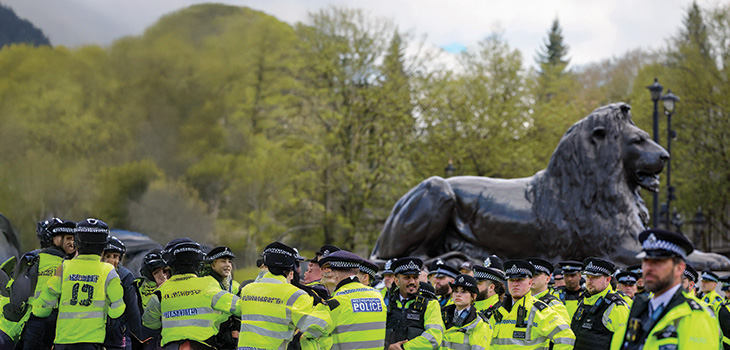
  • A Divisional Court decision finding use of facial recognition technology to be in accordance with the law has potentially significant implications for the use of artificial intelligence by public authorities.
  • The nature of the proportionality test has been discussed and clarified further by both the European Court of Human Rights and the Court of Appeal, with the latter also touching on the tricky goodwill/future income distinction under A1P1.
  • The courts have shown willingness to police the true purpose behind decisions and ensure that they are lawful and in accordance with the relevant legislation or policy.

Lawfulness of AI use

In R (Thompson and another) v The Commissioner of Police of the Metropolis [2026] EWHC 915 (Admin), the Divisional Court considered whether the police’s use of live facial recognition technology (LFR) was ‘in accordance with the law’ (IAWL) for the purposes of Art 8 of the European Convention on Human Rights (ECHR), and/or

If you are not a subscriber, subscribe now to read this content
If you are already a subscriber sign in
...or Register for two weeks' free access to subscriber content

MOVERS & SHAKERS

Gateley Legal—Jack Kelly

Gateley Legal—Jack Kelly

Gateley Legal expands Midlands residential development team

Gibson Dunn—Richard Surtees

Gibson Dunn—Richard Surtees

Gibson Dunn adds employee benefits and executive compensation practice in London with partner Richard Surtees

Laytons ETL—Alec Cameron

Laytons ETL—Alec Cameron

Laytons ETL appoints new partner and head of intellectual property disputes

NEWS
A series of recent decisions has clarified important principles across property law, from perpetuities to lease renewals and public rights over land
Employers cannot rely on wellbeing services alone to defend workplace stress claims after a High Court decision awarding almost £1m to an overworked employee
Andy Burnham's brand of 'Manchesterism' could offer fresh thinking on legal aid and access to justice if it reaches Westminster, according to Roger Smith, NLJ columnist and former director of JUSTICE
The constitutional fallout from a change of prime minister, rather than the politics, is under scrutiny as questions arise over the limits of executive authority in a leadership transition
The legal profession is undergoing a fundamental shift from selling services to creating technology-enabled products, according to Professor Luke Mason, Head of School of Law at Regent's University London
back-to-top-scroll
