As a leading provider of UKAS-accredited drug and alcohol testing, and a trusted training partner of the Judicial College, AlphaBiolabs recently had the opportunity to deliver a session on drug and alcohol testing to over 80 members of the judiciary.
Among the many insightful discussions that took place, there was a noticeable interest in alternative testing methods to complement hair testing – particularly nail testing.
Here, we take a closer look at nail drug and alcohol testing, its evidential value, and how it can be used to support or enhance other toxicology evidence.
What is nail testing and how does it work?
Nail testing is a toxicological method used to detect drug use or, in the case of nail alcohol testing, to monitor abstinence or chronic and excessive alcohol consumption over an extended period.
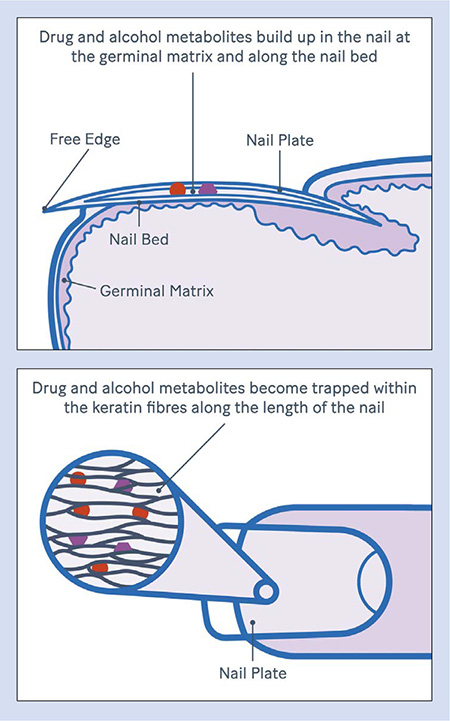
When a person consumes drugs or alcohol, these substances and their metabolites enter the bloodstream and become embedded in the keratin fibres of the nails as they grow (see box outs). Once deposited, these markers remain stable, providing a retrospective overview of substance use.
- Fingernail clippings offer an overview detection window of up to approximately 6 months
- Toenails grow slower than fingernails, so toenail clippings can provide an overview detection window of up to approximately 12 months
- As only nail clippings are required, sample collection is non-invasive and can be conducted discreetly. This makes nail testing a practical option across a range of legal and social care settings
When is nail testing appropriate?
Nail testing is especially useful when hair testing is unavailable or unsuitable. Common scenarios include:
- Absence or insufficiency of head hair (e.g. due to shaving, alopecia, or cultural/religious practices)
- Cases requiring corroborative evidence alongside behavioural or clinical assessments
- Suspected adulteration of hair samples, where bleaching, dyeing or excessive washing may compromise results
In such instances, nail testing provides a robust alternative. It is also highly relevant in child protection cases, where long-term patterns of drug or alcohol use need to be evidenced swiftly to inform safeguarding decisions.
Complementary use
While nail testing can be conducted independently, its evidential power is amplified when used in conjunction with other testing methods. Combining nail drug or alcohol testing with hair, blood, urine or oral fluid analysis allows legal professionals to:
- Cross-verify findings across biological matrices
- Extend the overall detection window (e.g. 6cm hair = 6 months + toenail clippings = up to 12 months)
- Support or challenge self-reported histories of abstinence or misuse
In alcohol testing, nail samples can complement blood biomarker testing – such as phosphatidylethanol (PEth) – to build a multi-source profile of alcohol use (proof of abstinence or supportive of chronic and excessive use). This is particularly valuable in care proceedings where establishing long-term parental behaviour is critical.
Understanding your options for drug and alcohol testing
As toxicological science evolves, it’s essential for the legal profession to remain up to date on the full range of testing options available, particularly when decisions in court can have far-reaching consequences for families.
Nail testing offers a reliable means of evidencing long-term substance use, and is effective as:
- a standalone option, when other sample types are not viable
- part of a multi-matrix testing strategy, to provide a more comprehensive evidential picture
Want to learn more? Register now for our FREE 40-minute webinar, The Right Test at the Right Time: drug & alcohol testing for every scenario, on Tuesday 17 June at 1pm and Thursday 19 June at 9am. alphabiolabs.co.uk/learning-centre/webinars
For more information or to request a quote, contact our New Enquiry team on 0333 600 1300 / testing@alphabiolabs.com or visit www.alphabiolabs.co.uk.