
header-logo header-logo

King Mob

23 November 2017 / Sir Geoffrey Bindman KC
Issue: 7771 / Categories: Features
printer mail-detail
nlj_7771_bindman

Disaffected citizens prepared to run riot are nothing new, says Geoffrey Bindman

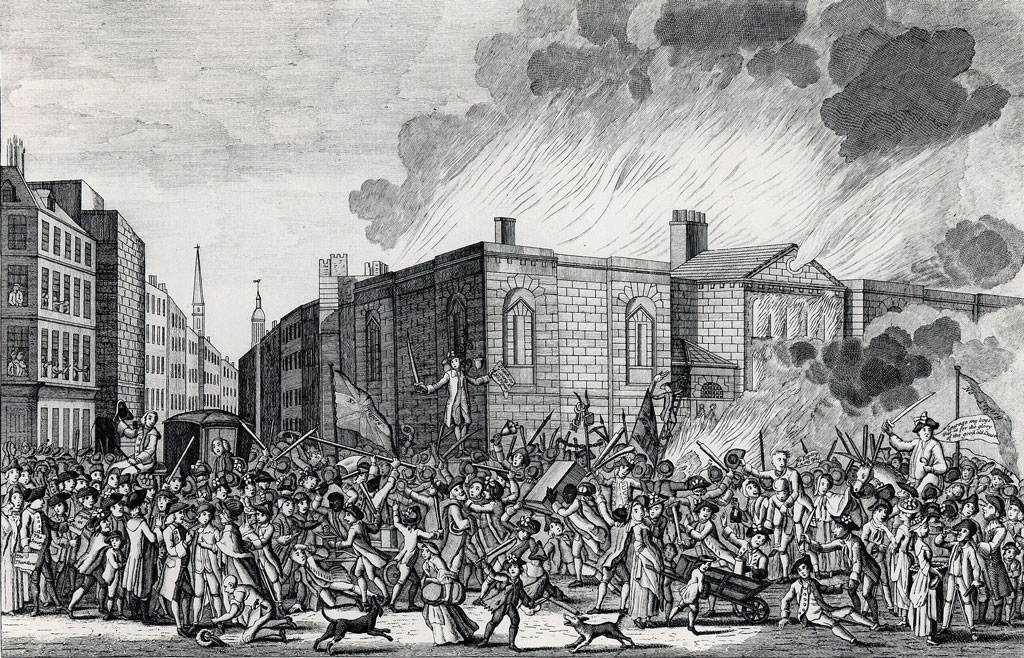
Apart from the Civil War in the mid-17th century, the Gordon Riots in 1780 remain the most serious outbreak of public disorder in English history. A century after the Popish Plot (see my article ‘Lessons from Scroggs LCJ’), anti-Catholic hostility had abated, but arbitrary restrictions on the rights of Catholics remained on the statute book, including their disqualification from service in the armed forces. Needing more soldiers to combat the American colonists fighting for their independence, Lord North’s government introduced legislation to allow Catholics to enlist. Many were glad to do so, but the hard-line Protestant Association, led by Lord George Gordon—Scottish aristocrat, Etonian demagogue and member of the English Parliament—was bitterly opposed. Lord George organised a petition to Parliament to be delivered by him at the head of a procession of no fewer than 40,000 supporters.

Inevitably, when this vast throng descended on Whitehall, after marching from its assembly point at St George’s Fields—later the site of Waterloo Station—violence broke out. Rioters entered the lobby of the House of Commons,

If you are not a subscriber, subscribe now to read this content
If you are already a subscriber sign in
...or Register for two weeks' free access to subscriber content

MOVERS & SHAKERS

Hogan Lovells—Lisa Quelch

Hogan Lovells—Lisa Quelch

Partner hire strengthens global infrastructure and energy financing practice

Sherrards—Jan Kunstyr

Sherrards—Jan Kunstyr

Legal director bolsters international expertise in dispute resolution team

Muckle LLP—Stacey Brown

Muckle LLP—Stacey Brown

Corporate governance and company law specialist joins the team

NEWS

NOTICE UNDER THE TRUSTEE ACT 1925

HERBERT SMITH STAFF PENSION SCHEME (THE “SCHEME”)

NOTICE TO CREDITORS AND BENEFICIARIES UNDER SECTION 27 OF THE TRUSTEE ACT 1925
Law firm HFW is offering clients lawyers on call for dawn raids, sanctions issues and other regulatory emergencies
From gender-critical speech to notice periods and incapability dismissals, employment law continues to turn on fine distinctions. In his latest employment law brief for NLJ, Ian Smith of Norwich Law School reviews a cluster of recent decisions, led by Bailey v Stonewall, where the Court of Appeal clarified the limits of third-party liability under the Equality Act
Non-molestation orders are meant to be the frontline defence against domestic abuse, yet their enforcement often falls short. Writing in NLJ this week, Jeni Kavanagh, Jessica Mortimer and Oliver Kavanagh analyse why the criminalisation of breach has failed to deliver consistent protection
Assisted dying remains one of the most fraught fault lines in English law, where compassion and criminal liability sit uncomfortably close. Writing in NLJ this week, Julie Gowland and Barny Croft of Birketts examine how acts motivated by care—booking travel, completing paperwork, or offering emotional support—can still fall within the wide reach of the Suicide Act 1961
back-to-top-scroll
