


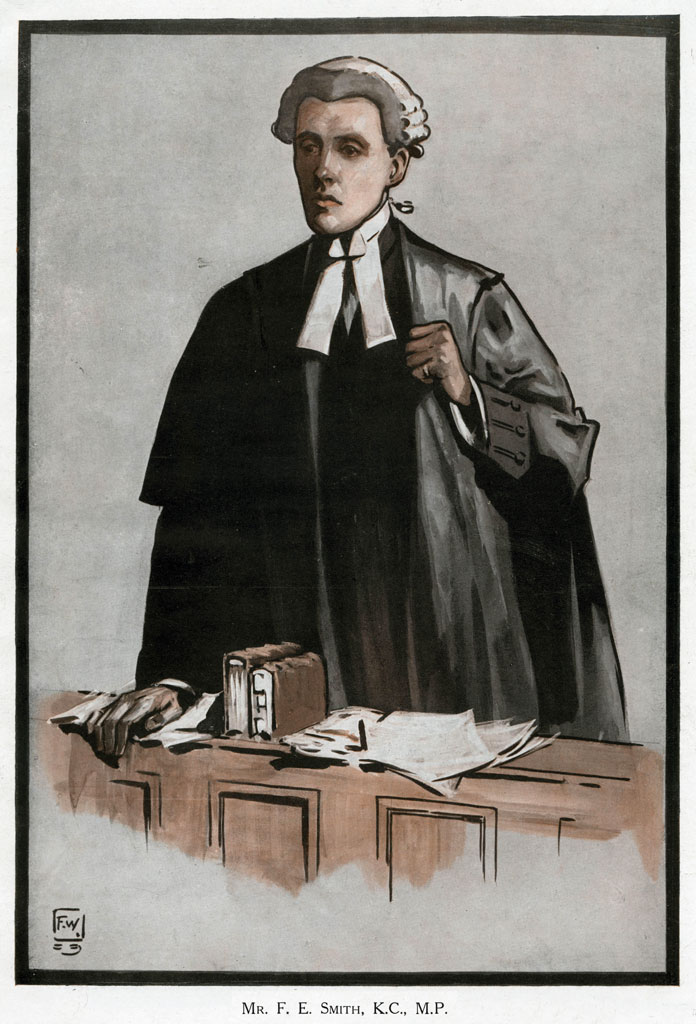
Geoffrey Bindman reflects on the life & career of Lord Birkenhead
Tony Blair was wrong to reject the advice of his friend Lord Irvine when he downgraded the role of lord chancellor as head of the judiciary and voice of the law in the Cabinet. Entrusting political responsibility for the management of the legal system to a secretary of state for justice based in the House of Commons is sensible, but merely adding the nominal title of lord chancellor to the holder of that office is no substitute for a powerful guardian of the independence of the judiciary and the priority of the law—now more under threat than ever—as a pillar of our constitution. Nor was he right to allow the office to be held by a non-lawyer, as the unhappy appointments of Chris Grayling and Liz Truss have demonstrated.
Yet we should not assume that all past lord chancellors have lived up to an austere ideal of selfless dedication to public service. The appointment of F E Smith (Lord Birkenhead, pictured), in 1918 at the early age of 46 was highly controversial. It was described by The Morning Post as ‘carrying a joke beyond the limits of pleasantry’. Yet Smith was on the face of it very well qualified. He was an outstanding law student at Oxford, then for several years taught law as a fellow of his college. He was then one of the most successful barristers of his time, attracting the high fees he needed to fund an extravagant lifestyle. After entering parliament in 1905 as a Unionist (Conservative), he held several ministerial offices and in 1915 was appointed attorney general.
Path to prominence
As a student he had embarked on a well-trodden path into politics by becoming a prominent speaker at the Oxford Union. There, according to one biographer, ‘he became the embodiment of its peculiarly facetious style of repartee’—a style still favoured by Oxonians in Parliament such as Boris Johnson and Michael Gove. At Oxford Smith doubtless also developed a talent for abusing his adversaries, including judges, with sarcastic wit. To one judge, who accused him of being offensive, he replied ‘as a matter of fact we both are. The only difference between us is that I am trying to be and you cannot help it’. To the same judge who said of Smith’s argument, ‘I am none the wiser, Mr Smith,’ he replied, ‘None the wiser, perhaps, my Lord, but certainly better informed’.
Unruly brilliance
His heavy drinking and frequently unruly behaviour explain the hostility he often aroused—such as that of The Morning Post and other newspapers. Yet his brilliance was widely acknowledged. Margot Asquith, wife of Herbert Asquith, said, ‘F E Smith is very clever, but sometimes his brains go to his head’. He was greatly admired and relied on by Lloyd George when he was prime minister. He retained the close friendship of other leading politicians such as Winston Churchill. During his tenure of the office of lord chancellor he undoubtedly made an important contribution to law reform, playing a major role in the 1925 property legislation, which introduced land registration and transformed the whole system of land ownership and inheritance.
In politics, he was, according to the historian David Cannadine, ‘the supreme right-wing demagogue between Lord Randolph Churchill and Sir Oswald Mosley’. This is hardly surprising, given his ferocious egotism. In a well-publicised speech which he delivered as Rector of Glasgow University in November 1923, he challenged the notion of idealism in public affairs. He attacked the League of Nations and ridiculed the prospect of international co-operation eliminating conflict: ‘Nothing is more apparent...than that politically, economically, and philosophically, the notion of self-interest not only is, but must be, and ought to be, the mainspring of human conduct.’ He encouraged his student audience by assuring them that ‘the world continues to offer glittering prizes to those who have stout hearts and sharp swords’. Thus he rationalised his vanity and ruthless ambition.
Disillusioned
He was, of course, right in the 1920s to be sceptical about promises of permanent world peace, though he was out of step with his colleagues in government. He nevertheless maintained good relations with other contemporary politicians but became disillusioned and withdrew from active involvement, devoting himself to commerce in order to make more money. He became disillusioned with politics and with the law. He declined to take part in the judicial role of the House of Lords and was much upset by the attempts of some of his colleagues to deny him his lord chancellor’s pension. He did not long survive his retirement and died in 1930 at the age of 58. His dissolute life had taken its toll.
To quote Cannadine again: ‘FE’s life was shamelessly, successfully and simultaneously devoted to self-advancement, self-advertisement, self-indulgence, and self-destruction.’ As lord chancellor, it would be difficult to claim that he did anything to enhance the standing of the judiciary or the legal profession. Yet, as The Times said in its obituary of him: ‘No public figure of his day has been more real to his contemporaries.’ Certainly he was a colourful source of public entertainment, but hardly a role model for the lawyers of today.
Sir Geoffrey Bindman QC, NLJ columnist & consultant, Bindmans LLP.
© Chronicle/Alamy Stock Photo





