


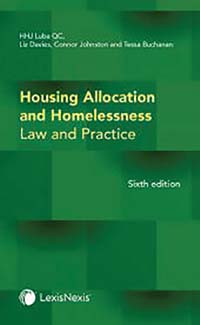
- Author: His Honour Judge Jan Luba KC, Liz Davies, Connor Johnston and Tessa Buchanan
- Publisher: Jordan Publishing
- ISBN: 9781784734329
- RRP: £129.99
Written by experts HHJ Luba KC, Liz Davies, Connor Johnston and Tessa Buchanan, this book offers an abundance of knowledge and experience, and provides a comprehensive breakdown of the respective legal frameworks.
At the beginning of the book there are succinct introductions which encapsulate the purposes, themes, research, fundamental statute and case law. In subsequent chapters procedure and process are the focus, looking at applications, eligibility, allocation and other powers and duties of local housing authorities. Each area highlights recent developments, following a turbulent four years since the last edition.
The developments of the Homelessness Reduction Act 2017 are touched on in different parts of the book, but discussed in detail at Chapters 7 and 15. The aim of the Act is explained to increase the onus on the local authority to take action before an individual becomes homeless. The Act is technical and sets out a range of duties, and commentary is given on the successes and shortcomings of the legislation. The main issues highlighted include the general failure of an applicant in securing affordable housing, and a tendency to get caught in the system.
The writers’ ability to maintain both clarity and course provides for an enjoyable read, in areas which often require comprehension of convoluted legislation and regulations. Each process is elucidated, with new case law for the practitioner to consider and apply. The discussion surrounding the relief duty is a key example of this. Discussed in detail at Chapter 15, practitioners are provided with recent case law highlighting the importance of having a personalised housing plan which accurately reflects the applicant’s circumstances and local authority’s role, in order for the preventative duty and/or relief duty to come to an end.
The Codes of Guidance are also well referenced, and the practitioner is frequently reminded of their use and purpose in reviewing allocation policies, following recent case law. Particular consideration is given to the use of definitions and categories as tools and not only guidance which is strictly inhibiting.
Regarding matters where there is an overlap with different areas of law—for example immigration law and eligibility—there is a comprehensive review on how the distinct areas interact and where to find this guidance. This is largely referring to the myriad of regulations and statutory instruments which make post-Brexit eligibility so intricate. The regulations are considered at length within Chapter 11 and the degree of detail distinguishes the book from others.
Given the politicisation of housing law, a holistic approach is often required and the consistent referencing to different chapters and areas helps create this. This is supported by, where appropriate, comparisons to the Welsh and Scottish framework and references for further reading.
While the book is, in my opinion, essential for practitioners’ use, it also serves generally as a reminder of the development of social housing and the ever-changing landscape. Bearing these points in mind, it is important that the text remains impartial and shows a perspective across the board. While there is reference to government policy and campaigns ran by Shelter and Crisis, and rightly so, there is a potential gap within housing allocation where the growing role of Registered Providers could be discussed.
Reviewer: Kathryn Bullen, solicitor at Ward Hadaway (www.wardhadaway.com).





