


Nominations for this year’s Legal Aid Lawyer of the Year awards are now open. The Legal Aid Practitioners Group, which organises these non-profit-making awards, is seeking nominations in 11 categories (see below), including a new award for 2021, for Disability Rights.
LALY21 key information
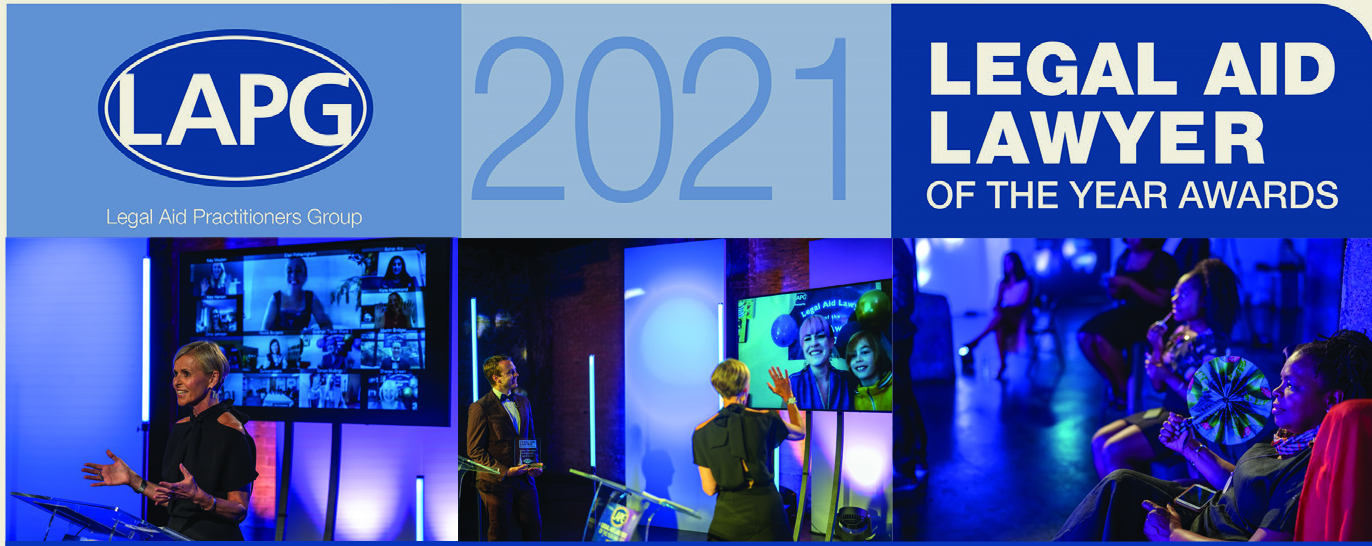
Following the success of last year’s lockdown LALY awards and ongoing Covid-19 restrictions, this year’s ceremony will also be broadcast live online
We are seeking nominations in 11 categories. Winners will be announced at a live ceremony, which will be free to attend, on 6 July 2021.
Legal Aid Newcomer;
Family Legal Aid;
Criminal Defence;
Legal Aid Barrister
Social Welfare Law;
Public Law;
Legal Aid Team;
Housing
Legal Aid Firm/Nor-for-profit Agency
Regional Legal Aid Firm/Not‑for-profit Agency
Disability Rights—new for 2021
Plus, the LALY judges will be making an award for: Outstanding Achievement
Follow us on Twitter for the latest LALY21 news @LALYawards (lapg.co.uk/lalys)
As always, the judges will also be making an award for Outstanding Achievement, to recognise the individual (or organisation) who this year deserves the highest honour the LALYs can bestow. Previous winners of the Outstanding Achievement award include Sue James, formerly of Hammersmith and Fulham Law Centre, newly installed as director of Legal Action Group; Lord Justice McFarlane, now president of the Family Division; the legal teams acting in the second Hillsborough Inquest; Public Law Project; plus a host of solicitors known for their dogged and ground-breaking work to secure justice for their clients, often in the face of extraordinary odds: Imran Khan QC; Gareth Peirce; Louise Christian; Raju Bhatt.
The LALYs are now into their 19th year. During that time, they have grown from small beginnings in 2003 to become an established and increasingly important fixture on the legal aid calendar. As the climate for legal aid lawyers and their clients has become bleaker, so the significance of the awards and the warmth of the profession’s affection for the LALYs has grown.
Russell Conway (LALY winner, 2013), senior partner at housing firm Oliver Fisher, reacted to news of the impending launch of LALY21 last month by tweeting: ‘It’s that moment, when you are trudging through the desert. Scorching temperatures, no water, hallucinations starting to take over, despair sets in—and then you see the oasis of the LALY awards.’
Jo Renshaw (LALY winner, 2015), head of immigration at Turpin & Miller, previously tweeted: ‘When I am having a particularly crappy day, I do bring to mind the LALY award like a warm hug.’ Kaweh Beheshtizadeh (LALY winner, 2017), describes winning his LALY as ‘the biggest achievement of my life’. Aika Stephenson (LALY winner 2007 and 2018), legal director at youth justice charity Just for Kids Law, is the only person to date to win two individual LALY awards. She speaks of the sense of ‘community and pride’; and describes of her most recent win as ‘definitely one of the happiest evenings of my career’.
Like last year’s ‘lockdown LALYs’, the LALY21 ceremony on 6 July will be online—broadcast live, with the winners streamed into the celebrations when their names are announced. As Jenny Beck, LAPG co-chair, said welcoming the 600-plus viewers to the 2020 event, ‘this may be a virtual ceremony, but our pride in you has never been more real’. A recurring theme last year—which is likely to be repeated again this time—was the devastating impact of the pandemic on clients and the lawyers who serve them. Sheree Green, winner of the Mental Capacity award, spoke of the number of clients who had died from COVID-19. For one winner, it was even closer to home.
Niall Murphy, who accepted Belfast-based KRW Law’s award as the inaugural Regional Legal Aid Firm of the year, had been seriously ill with the disease, spending 16 days on a ventilator in an induced coma. He had been recuperating in Donegal, with no broadband access, but in a demonstration of the doggedness KRW is known for and the special place the LALYs have in the heart of the profession, Niall had driven back to Belfast earlier in the day, just so he would be able to join the ceremony if his firm won.
It was a very special evening and the small team that organises the LALYs is looking forward to building on last year’s success to create an equally special celebration again this year.
Fiona Bawdon is a legal affairs journalist and co-founder of the LALY awards; Chris Minnoch is CEO of the Legal Aid Practitioners Group.





